AI Agents
AI Agent
Beginner
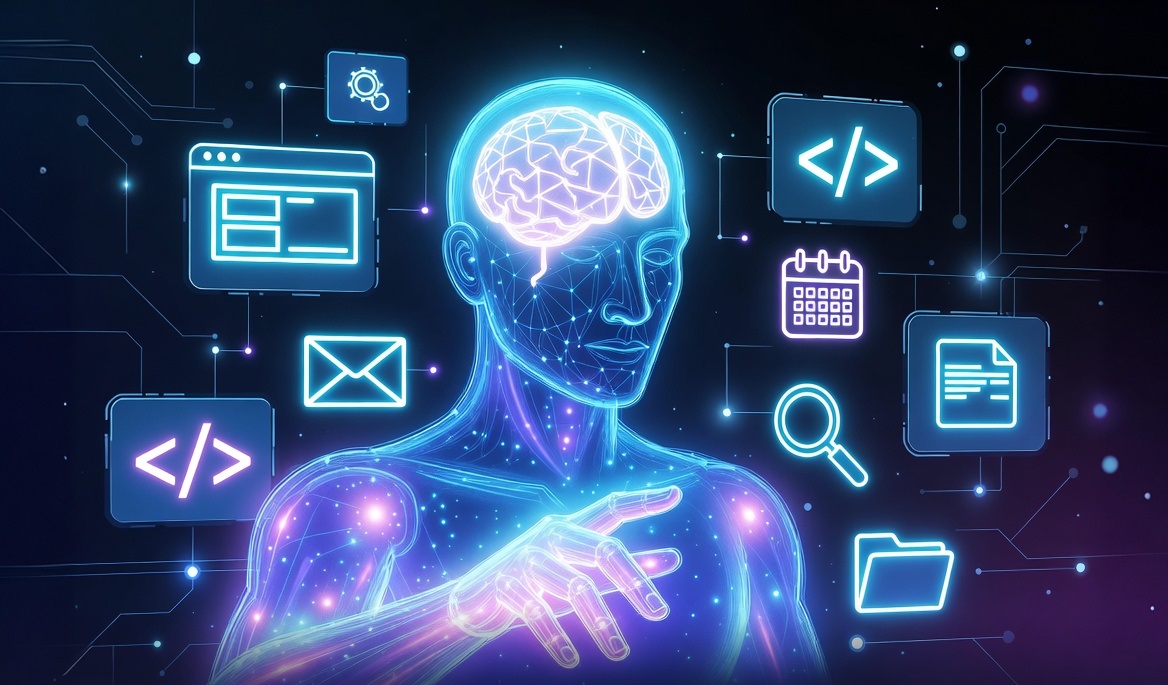
AI agents are systems that go beyond answering questions—they can understand goals, make decisions, and take actions autonomously. Powered by models like ChatGPT, they combine reasoning (the “brain”) with tools (the “body”) to plan and execute real tasks.
Unlike traditional AI, which only provides information, AI agents can complete workflows, adapt to changes, and interact with real systems. As they evolve, they’re transforming AI from a passive tool into an active digital assistant, while also raising important questions around ethics, control, and responsibility.
What Is an AI Agent? The Complete Beginner’s Guide
From Chatbots to AI Agents: The Big ShiftWe’ve seen AI evolve rapidly:
- First, we had simple rule-based systems.
- Then came powerful Large Language Models like ChatGPT that could generate impressive text.
- Now, we’re entering the era of AI agents, systems that don’t just talk, they act.
How Does an AI Agent Work?
- Perceives: Understands the user’s request and gathers relevant information from its environment.
- Thinks & Plans: Uses reasoning to break down the goal into actionable steps.
- Acts: Executes tasks using available tools and observes the results.
- Adapts: Adjusts its approach based on outcomes and continues until the goal is achieved.
The Anatomy of an AI Agent: Brain + Body
1. The Brain (The AI Model / LLM)
2. The Body (Tools & Capabilities)
- Web browsing and searching
- Sending emails
- Reading/writing documents
- Running code
- Accessing calendars or databases
- Controlling other applications
- Database queries
This distinction is critical:
- Tools are individual functions (e.g.,
send_email,search_web) - Actions are higher-level tasks that may involve multiple tools
For example:
“Schedule a meeting” (action) might involve:
- Checking availability
- Creating a calendar event
- Sending invitations
Each step uses different tools, but together they form a single action.
Why Planning Is the Core of Intelligence
Planning is what separates basic AI systems from truly capable agents.
A strong AI agent doesn’t just react—it:
- Breaks complex goals into steps
- Chooses the optimal order of execution
- Anticipates potential issues
- Adjusts strategy dynamically
For example, planning a trip isn’t one action—it involves research, comparison, booking, and scheduling. A good agent orchestrates all of this seamlessly.
The Role of LLMs in AI Agents
Large Language Models are the decision-making engine of AI agents.
They enable:
- Natural language understanding
- Logical reasoning
- Task decomposition
- Tool selection
However, LLMs alone are not enough. Without tools, they can only suggest actions—not perform them.
That’s why modern AI agents combine LLMs + tools + execution logic.
The Spectrum of AI Agents
Not all agents are equally capable. They exist on a spectrum:
Basic Systems
- Generate outputs only
- No real decision-making
Decision-Based Agents
- Route tasks based on conditions
- Perform simple logic
Tool-Using Agents
- Call external functions
- Interact with systems
Multi-Step Agents
- Plan and execute complex workflows
- Iterate until completion
Multi-Agent Systems
- Multiple agents collaborate
- Each handles specialized tasks
The more advanced the agent, the more autonomy and complexity it can handle.
Real-World Examples of AI Agents
AI agents are already being used across industries:
- ChatGPT assisting with writing, coding, and research
- Siri managing reminders and device control
- Netflix recommending personalized content
- Customer support bots resolving user issues
- Trading systems executing market strategies
- Automation tools managing workflows across apps
The key difference: they don’t just inform, they act.
Key Characteristics of AI Agents
AI agents stand out because they are:
- Autonomous – operate with minimal supervision
- Goal-driven – focused on achieving outcomes
- Interactive – able to use tools and systems
- Adaptive – improve decisions based on feedback
- Action-oriented – capable of execution, not just suggestion
AI Agents vs Traditional AI
| Feature | Traditional AI | AI Agents |
|---|---|---|
| Output | Information | Actions |
| Interaction | Passive | Active |
| Decision-making | Limited | Advanced |
| Autonomy | Low | High |
This evolution marks a major turning point in AI development.
Ethical Implications of AI Agents
As AI agents become more autonomous, ethical considerations become more important:
Accountability
Who is responsible when an AI agent makes a mistake?
Transparency
Users need to understand how decisions are made.
Privacy
Agents often access sensitive data—this must be handled securely.
Control
There must always be limits to prevent unintended actions.
Building responsible AI agents means balancing power with oversight.
Why AI Agents Matter
AI agents represent a shift from:
- Manual work → automated workflows
- Tools → collaborators
- Instructions → outcomes
They have the potential to:
- Save time
- Increase productivity
- Reduce human error
- Enable entirely new ways of working
Building AI Agents with Frameworks (Example: LangGraph)
While an AI agent is fundamentally a software system, it doesn’t have to be built from scratch. Today, there are specialized frameworks that make it much easier to design, manage, and scale agents. One notable example is LangGraph.
What Is LangGraph?
LangGraph is a framework designed to build stateful, multi-step AI agents. Instead of treating an agent as a single prompt-response interaction, it models the agent as a graph of steps, where each node represents a piece of logic (like reasoning, tool use, or decision-making).
This structure makes it particularly useful for agents that need to:
- Handle complex workflows
- Maintain memory across steps
- Loop, retry, or adjust actions dynamically
Why Use a Framework Like LangGraph?
Building an agent involves more than just calling an AI model like ChatGPT. You need to manage:
- Execution flow (what happens next?)
- Tool integration (what can the agent do?)
- State and memory (what does it remember?)
- Error handling and retries
Frameworks like LangGraph provide these capabilities out of the box, allowing developers to focus on logic and outcomes rather than infrastructure.
How It Fits Into the Agent Model
If we think back to the “brain + body” idea:
- The LLM (brain) handles reasoning and planning
- The framework (like LangGraph) manages the flow of decisions
- The tools (body) execute actions in the real world
LangGraph essentially acts as the orchestrator, ensuring that all parts of the agent work together smoothly.
When Should You Use It?
LangGraph is especially useful when:
- Your agent requires multi-step reasoning
- Tasks involve loops or conditional flows
- You need reliable execution and control
- You’re building production-level AI systems
In short, frameworks like LangGraph turn the idea of an AI agent into something practical, structured, and scalable—bridging the gap between powerful AI models and real-world applications.
to learn how to create an agent using LangGraph click here.
Final Thoughts
AI agents are not just an upgrade, they’re a fundamental change in how we interact with technology.
By combining reasoning, planning, and action, they transform AI into something far more useful: a system that can actually get things done.
As these systems continue to evolve, they will reshape industries, redefine productivity, and become a core part of everyday life.
AI agent LangChain LangGraph Python